
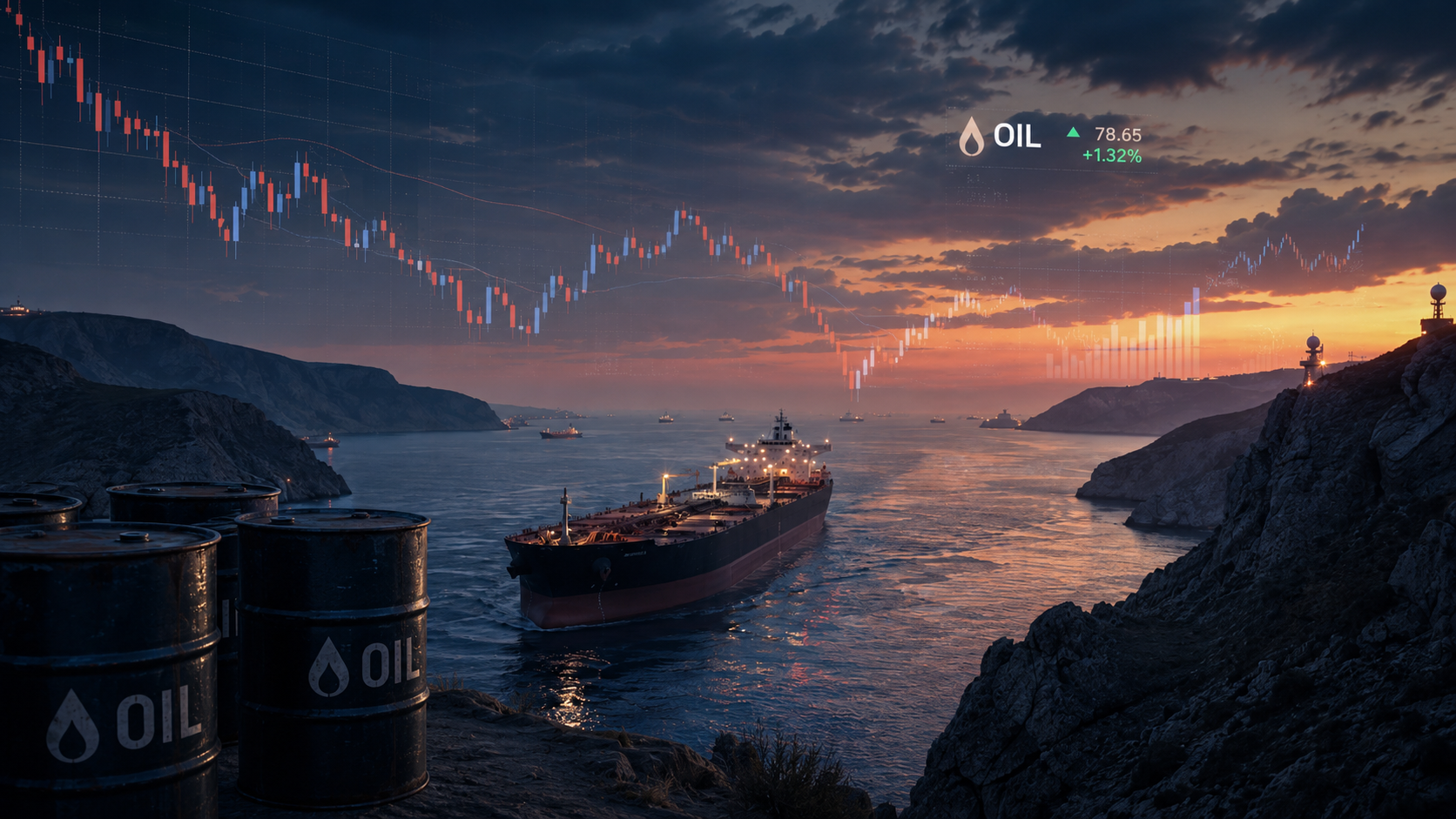
The market has rapidly stripped out part of the geopolitical risk premium, betting on a normalization of the Strait of Hormuz. Yet shipping activity, insurance conditions and physical oil flows tell a more complicated story. The sharp moves in WTI over the past few days show just how much the price is now being driven not only by what is happening today, but by what traders believe could happen over the coming weeks.
There are times when the oil chart tells most of the story. Then there are moments like this one. WTI is no longer reacting simply to US production, Cushing inventories or OPEC+ decisions. It is trying to put a price on something far less measurable: the probability that the Middle East crisis normalizes BEFORE it causes further damage to the global energy system.
That changes the way the market needs to be analysed. The question is no longer simply how many barrels are being produced, but how many of those barrels can actually reach the market and, perhaps more importantly, how much of a return to normality has already been priced in despite that normalization remaining incomplete.
It is precisely in the gap between these two dimensions — financial expectations and physical reality — that one of the most interesting divergences in today’s oil market is emerging.
The market bought the deal before there was a deal
The first few days of August offered an almost textbook example of how quickly oil can be repriced when geopolitical expectations shift. On August 3, after a planned US strike against Iran was called off and Donald Trump suggested that an agreement might be possible, WTI fell roughly 5.1% in a single session, closing at $80.34 per barrel. Brent fell even more sharply, losing around 7% to $83.77.
The move was particularly significant because Tehran was simultaneously denying that negotiations with Washington were actually taking place.
The selling did not stop there. By August 5, WTI had fallen to around $75.22, more than 6% below its August 3 level and roughly 11% below the $84.67 area from which the first major correction had begun.
In just a few days, the market had wiped almost $10 off the price of a barrel without millions of new barrels suddenly appearing, without Hormuz fully reopening and without Gulf energy infrastructure returning to normal operating conditions.
What had changed above all was the probability the market assigned to what might happen next.
Up to this point, that is simply how financial markets work: prices do not wait for the future to arrive. They try to anticipate it.
The problem begins when expectations move much faster than reality.
Evidence of that came almost immediately.
On August 6, as concerns resurfaced over possible Iranian restrictions on traffic through the Strait and Tehran’s parliament began considering measures targeting US and Israeli-linked vessels, WTI rebounded 2.75% in a single day, rising from $75.22 to $77.29.
The following day, renewed hopes for a temporary agreement pushed crude slightly lower again, toward $76.96.
The sequence matters more than any single price:
$84.67 → $80.34 → $75.22 → $77.29
all within a matter of days.
That does not describe a market in which the physical availability of oil is changing at the same speed. It describes a market repeatedly reassessing the probability of peace, reopening and normalization.
And that volatility itself shows just how fragile those expectations remain.
Hormuz: a political agreement is not yet an oil-market agreement
The Strait of Hormuz remains the centre of the problem. Simply using the word agreement can create the impression that the crisis is rapidly moving toward a solution, but there are at least three different forms of reopening: political, physical and economic.
Iran and Oman may reach a diplomatic understanding on the theoretical conditions under which vessels can transit the Strait, but that does not automatically mean shipowners will be willing to send their tankers through it, nor does it mean insurers will be prepared to provide coverage on economically viable terms.
The discussions between Tehran and Muscat highlight just how wide that gap remains. On August 5, Iran and Oman had reached an understanding over the coordinates of a possible route through Hormuz, yet several critical details were still under negotiation despite much more optimistic public messaging surrounding the prospect of a final deal.
The following day, shipping industry sources were describing the proposed framework as difficult to implement under the terms being discussed. Iran was reportedly seeking fees equivalent to 5% to 7% of the value of the cargo, while Oman was considering a solution closer to 3%. Washington, meanwhile, supported the principle of passage without tolls.
And cost is only part of the problem.
Payments to Iranian authorities may conflict with US sanctions, while clauses introduced within the London marine insurance market could cause certain war-risk cover to lapse if vessels make those payments.
A company could therefore be politically permitted to transit the Strait while still being unable to do so on economically or legally sustainable terms.
As long as these issues remain unresolved, simply referring to a “reopening of Hormuz” risks describing a diplomatic intention rather than a genuine normalization of the oil market.
The definitive proof, in other words, will not come from a press conference.
It will come from the sea.
Ships are harder to convince than markets
Shipping data continues to tell a much less reassuring story.
Between Monday and Thursday this week, only 33 vessels passed through Hormuz, down from 50 over the same period a week earlier. Just four transited on Thursday, while only six crude oil tankers exited the Strait over the course of the week.
Those numbers remain a long way from anything resembling normal operating conditions for the Gulf’s most important energy artery.
Even more revealing is what is happening with Iraqi crude.
State oil marketer SOMO has offered Basrah Heavy and Basrah Medium at discounts of as much as $30 per barrel for August cargoes.
Under normal circumstances, discounts of that size would suggest a heavily oversupplied market. Yet some Chinese and Indian buyers interested in the crude have been unable to secure vessels because many shipowners still consider the risks of entering the Strait too high.
That completely changes the meaning of the discount.
It does not necessarily signal an excess of oil on the global market. It may instead indicate stranded oil — barrels available in the wrong place and unable to reach the market where they are needed.
A barrel can be produced, stored and formally offered for sale, but if no vessel is willing to transport it, it does not carry the same economic value as a barrel that can be delivered immediately.
That is why headline production tells only part of the oil story. Production capacity, exports, transportation and final delivery are different links in the same chain, and a disruption in just one of them can fundamentally change the value of all the others.
The price of oil is also the price of logistics
This distinction helps explain many of the apparent contradictions in the current market.
If insurance risk rises sharply, part of the supply becomes economically less accessible. If a tanker risks sanctions for making a payment required to transit a shipping lane, effective availability falls. If an export terminal remains operational but shipowners avoid the area, nominal production capacity immediately becomes less relevant.
It is therefore entirely possible to have plenty of oil in one location and scarcity on the international market at the same time.
This is also why OPEC+ production quotas need to be interpreted more cautiously in the current environment. A quota authorizes production, but it does not guarantee that those barrels will actually reach the end buyer.
Paradoxically, this makes OPEC+ less relevant in the very short term but potentially much more important if Hormuz truly returns to normal.
If the Strait becomes fully operational again, the market could suddenly absorb several sources of supply at once: Gulf production currently constrained by the crisis, cargoes that have been delayed or trapped, greater Iranian export capacity and additional OPEC+ volumes already approved under higher quotas.
Oil that appears unavailable today could quickly become effective supply tomorrow.
The current dislocation therefore supports prices, but its resolution could produce exactly the opposite effect.
When communication becomes a market variable
The events of the past week have also shown how political communication has become an integral part of oil price formation.
Highly optimistic statements about the possibility of reaching an agreement quickly had an immediate effect on futures prices. Yet over the following days, additional conditions, insurance obstacles and diplomatic differences emerged, leaving the underlying situation far less settled than initial market reactions had implied.
On August 5, for example, regional sources indicated that several details of the arrangement were still being negotiated, in contrast with the widespread perception that a deal was virtually imminent.
There is no need to interpret this mechanism as deliberate market manipulation in order to recognize its significance.
Governments, producing countries and major oil consumers all have different economic interests when it comes to the price of crude, and their public statements inevitably influence expectations that can be worth several dollars per barrel.
In a market this sensitive, the difference between “constructive talks”, “a deal is close” and “an operational agreement is in place” is far greater than it may appear in everyday language.
The August price action illustrates that clearly. The market rapidly priced in the prospect of de-escalation, while actual traffic through Hormuz failed to normalize at anything close to the same speed.
When developments emerged that challenged that assumption, WTI responded almost immediately to the upside.
Rather than asking whether one particular statement was overly optimistic, it is more useful to watch the distance between the degree of certainty perceived by the market and the degree of certainty later confirmed by the facts.
That gap is often where volatility is born.
Inventories can also tell an incomplete story
The distinction between apparent availability and effective availability extends well beyond Hormuz.
Oil inventories can also be misleading when viewed without considering where those barrels are physically located.
An increase in oil stored at sea alongside a decline in onshore inventories tells a very different story from a broad-based build across storage terminals. The former may simply reflect logistical delays and cargoes waiting for destinations rather than a market that is comfortably supplied.
The same applies in the United States, where weekly changes in commercial crude inventories need to be considered alongside the Strategic Petroleum Reserve, imports, refinery activity and, above all, refined-product inventories.
The amount of crude that exists on paper does not always match the amount of usable energy immediately available to the system.
In a heavily disrupted market, that distinction can become critical.
Diesel is telling a story WTI alone does not show
Another important signal is coming from refined products.
Crude oil, diesel, gasoline and jet fuel are not interchangeable. Turning the first into the others requires refining capacity, and that capacity remains under pressure in several parts of the world.
The result can appear paradoxical: crude loses part of its geopolitical premium while diesel and other refined products remain considerably tighter.
This divergence matters because high refining margins give operating refineries a strong incentive to process as much crude as possible. Over time, that can support oil demand even when the spot crude price appears relatively weak.
The same logic applies to attacks on Russian refineries.
Damage to refining infrastructure should not automatically be interpreted as an equivalent reduction in crude supply. If upstream production continues while domestic refining capacity falls, Russia may end up with less diesel but more crude available for export.
A headline that appears bullish for “oil” can therefore have very different consequences for crude and refined products.
Brent and WTI are experiencing the same crisis from different angles
Brent is naturally more exposed to disruptions affecting international Gulf flows and therefore tends to carry a larger geopolitical risk premium.
WTI, by contrast, benefits from the scale of US production and a logistics system that is relatively more insulated from the immediate Middle East disruption.
Yet the difference between the two benchmarks creates its own balancing mechanism.
When Brent trades at a significant premium to WTI, US crude becomes more competitive on the international market, increasing incentives for American exports.
Higher exports mean greater demand for WTI and potentially lower US inventories.
A shock originating in the Strait of Hormuz can therefore eventually reach Cushing not because the United States depends directly on those barrels, but because global crude arbitrage connects the two markets.
The chart still matters, but it has to be read alongside the narrative
Technical analysis does not become useless in a market like this, but its role changes.
Price levels can help identify when the market is shifting its interpretation of events, particularly when those levels are considered alongside physical and geopolitical developments.
The $75-$76 area represented the point this week where optimism over de-escalation exerted its strongest pressure on WTI.
A sustained break below that zone accompanied by a genuine rise in traffic through Hormuz would mean something very different from the same break caused only by another round of diplomatic headlines.
Similarly, the $80-$81 area now represents an initial zone that could show whether the market is rebuilding part of the geopolitical premium, while a move back toward $84-$85 would effectively reverse most of the sharp correction triggered by hopes of an agreement on August 3.
Technical levels therefore become most useful when they are treated as a gauge of expectations rather than as a standalone explanation for price action.
The real crossroads for WTI
The market can develop in two main directions, with a wide middle ground of negotiations, partial reopenings and continuous revisions to expectations.
If Hormuz genuinely normalizes — more vessels, renewed insurance availability, completed fixtures, rising exports and lower risk premiums — downside pressure on WTI could become considerably stronger than what has been seen so far.
At that point, expectations would finally be followed by physical barrels.
If, on the other hand, the market discovers that a political agreement does not produce an economically viable reopening, the process could reverse.
WTI would not necessarily need another major military escalation to recover. It would simply require part of the normalization already embedded in the price to be questioned.
The jump from $75.22 to $77.29 in a single session already offers a small example of how quickly that reassessment can happen.
There is also a much more extreme scenario: renewed damage to Gulf energy infrastructure.
Iran has already threatened retaliation against critical regional infrastructure in the event of further US escalation. Such an outcome would shift the problem from logistics to production itself — no longer merely barrels temporarily trapped or delayed, but physical capacity potentially removed from the system.
Conclusion: the market is pricing a normality that still has to prove itself
The Hormuz crisis highlights one of the most important characteristics of the oil market: price does not simply represent what exists today. It represents what millions of market participants believe is most likely to exist tomorrow.
That ability to anticipate the future makes markets efficient, but it also leaves them vulnerable to sharp reversals when expectations move faster than fundamentals.
Recent WTI price action provides an almost perfect example.
From around $84.67 to $75.22, a decline of more than 11%, followed by a partial rebuilding of the risk premium that pushed prices back toward $77.
All of this happened while traffic through Hormuz remained heavily constrained, shipowners continued to exercise caution and the details of any agreement remained problematic enough to cast doubt on immediate implementation.
The key question is therefore not whether the market is right or wrong to bet on de-escalation.
If vessels begin moving normally again over the coming days, insurance conditions improve and Gulf cargoes return to the international market, prices will simply have anticipated the future correctly.
If normalization remains largely diplomatic rather than physical, however, the gap between expectations and reality may become increasingly difficult to sustain.
And that is probably the most important question facing the oil market over the coming weeks:
not whether an agreement will be announced, but how much oil will actually be able to move through it.
Transparency note: this article was produced with the support of generative artificial intelligence tools.